
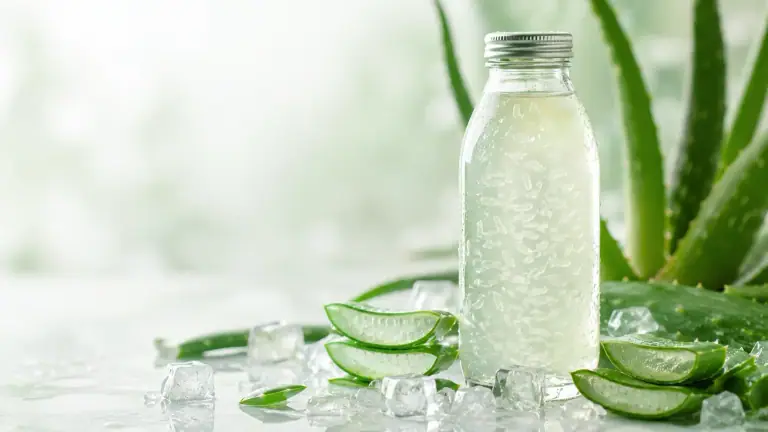
Developing a Private Label Aloe Vera Drink: Pulp, Sugar, Flavour, Pack and Shelf Life
A private label aloe vera drink is a formulation and packaging project, not an off-the-shelf product. Brief the aloe pulp level and cube size, sweetness, flavour, pack format and label market before any artwork is designed. Then approve bench samples, validate the formula in its final pack, and check the destination market's aloe and labelling rules before printing.
Start with a written brief, before artwork
A costly mistake in a private label drink project is finishing the label before the formula and the pack are technically approved. A short brief avoids it:
| Brief item | Why it matters |
|---|---|
| Aloe pulp level and cube size | Texture, cost, filling method, label declaration |
| Sweetness (Brix target) and sweetener system | Taste, sugar content, claims, sugar taxes |
| Flavour and colour reference | Consumer expectation and ingredient choice |
| Pack: PET, can or glass; size; closure | Filling line, shelf life, cost per unit |
| Label market and intended claims | Ingredient, nutrition, claim and language rules |
| Annual volume and launch date | Line scheduling, packaging minimums |
| Documents required | Certificates and lot documents for your importer |
With the brief agreed, the factory prepares bench samples; the approved sample becomes the reference for the formula, and only then does artwork start.
How much aloe pulp should the drink contain?
There is no ideal percentage. The aloe pieces — cubes of aloe gel cut from the inner leaf — are the signature of the drink, and their level is a balance:
- More pulp gives more texture and a stronger aloe identity, but costs more, needs fillers that handle particles, and makes pieces more likely to settle or float.
- Cube size changes the drinking experience through the bottle neck or can opening; very large pieces feel chunky, very small ones feel like sediment.
- Declaration. In the EU, naming or picturing aloe on the label generally triggers a quantitative ingredient declaration, subject to the applicable exceptions. State the percentage in or immediately next to the food name, or alongside aloe in the ingredient list. Our specification sets the aloe gel pulp percentage per buyer and declares it accurately.
Approve the pulp level on a physical sample, filled in the chosen pack, not on a recipe sheet.
How sweet, and what can the label claim?
Sweetness is a formulation choice: we produce standard, low-sugar and no-added-sugar recipes, and every sugar or nutrition claim is reviewed for the destination market before it goes on the pack. For drinks, the EU thresholds are:
| Claim (EU) | Condition for liquids |
|---|---|
| Low sugars | Not more than 2.5 g sugars per 100 ml |
| Sugars-free | Not more than 0.5 g sugars per 100 ml |
| No added sugars | No added mono- or disaccharides or other food used for sweetening; “contains naturally occurring sugars” if sugars are naturally present |
| Reduced sugars | At least 30% less than similar products, and energy no higher |
In the US, “sugar free” requires less than 0.5 g of sugars per reference amount customarily consumed and per labelled serving, plus other conditions, and “no sugar added” has its own conditions under 21 CFR 101.60. Several markets also tax sugary drinks by grams of sugar per 100 ml, which can make a small recipe change worth a lot. If you plan to use non-nutritive sweeteners, name the market first: permitted sweeteners and their labelling differ between jurisdictions.
Can the flavour be customised?
Yes, where the approved formula and the ingredient supply support it. Define the flavour by a reference — a benchmark product or a described profile — and approve it on bench samples, not by name. How the flavour is described on the label depends on where it comes from: fruit juice, fruit concentrate or flavourings. In the EU, “natural” flavouring descriptions are regulated, so agree the flavour source before writing the front of pack.
PET, can or glass?
PET shows the aloe pieces and is resealable, an intact can provides a strong barrier to oxygen and light, and glass positions the drink as premium. The table compares them.
| Aspect | PET bottle | Aluminium can | Glass bottle |
|---|---|---|---|
| Shows the aloe pieces | Yes | No | Yes |
| Barrier to oxygen and light | Lower | High; opaque, with intact seams and closure | High (light depends on glass colour) |
| Resealable | Yes | Usually no | Yes |
| Weight and freight | Light | Light | Heavy, breakable |
| Processing | Hot-fill or aseptic cold-fill, depending on the line | Filled and heat-treated in the can | Hot-fill or pasteurised |
| Typical positioning | Mainstream and convenience | Mainstream, vending, multipacks | Premium |
PET is a common choice for aloe drinks because the pieces are visible. Cans provide strong protection against oxygen and light, at the cost of that visibility; final quality also depends on the lining, seams and validated process. Which formats are possible depends on the producing factory’s capability; we confirm the fill size and pack at the quotation stage.
Which bottle or can sizes are possible?
Single-serve bottles and cans are common formats for aloe drinks. Whether a particular volume is available depends on the existing bottle moulds or preforms, can sizes, closures, cartons, and the cost of changing the line over. A new size can be possible but may bring tooling costs and larger minimums. Confirm the exact size, closure and carton configuration before the label is designed — the label dimensions depend on them.
How is shelf life validated?
Our aloe drinks carry a typical ambient shelf life, shown in the table below, which depends on the formula, the heat treatment and the pack and is confirmed by validation. Validation for a new formula in its final pack covers:
- microbiological stability after the chosen heat treatment, at ambient storage;
- physical stability: aloe pieces staying suspended, sediment, cloud, colour;
- sensory stability: flavour and sweetness over time;
- pack integrity: seals, closures, can seams, and for PET, oxygen ingress over the shelf life.
Plan the validation before launch; a real-time study in the final pack is the reference.
What aloe-specific rules should you check?
Aloe drinks need three checks beyond general food law: aloin and hydroxyanthracene derivatives in the EU, Proposition 65 in California, and the acidified-food rules in the US.
- EU — aloin and hydroxyanthracene derivatives. Commission Regulation (EU) 2021/468 restricted preparations from aloe leaf containing hydroxyanthracene derivatives, compounds found mainly in the leaf’s outer latex. The EU General Court annulled the prohibition on those aloe preparations on 13 November 2024 (Case T-189/21), and the Commission appealed in Case C-38/25 P. Under Article 60 of the Statute of the Court of Justice, annulment of a regulation generally does not take effect while a timely appeal is pending; check the current case status and applicable rules before you finalise the specification. Confirm that the selected ingredient meets the applicable legal requirements. Specify inner-leaf aloe gel processed to remove latex, with the processing description and an aloin test result available; this documentation alone does not establish legal compliance.
- US — Proposition 65. California lists “aloe vera, non-decolorized whole leaf extract” as a chemical known to cause cancer. The listing names non-decolourised whole-leaf extract, so specify decolourised inner-leaf gel and ask for the processing description and an aloin test result.
- US — acidified and low-acid canned foods. Depending on formulation and pH, a shelf-stable drink may be regulated under 21 CFR Parts 108, 113 or 114, which require a registered processing establishment and a filed scheduled process. Our US import guide covers the wider FDA requirements.
What about aloe vera drinks with chia seeds?
Chia seeds add texture and a visible point of difference, and they bring their own development work: seed hydration, suspension in the bottle, heat treatment and filling. In the EU, chia seed is a novel food authorised for specified food categories and use levels, so check that the drink and its chia content fit the authorisation. Our aloe vera juice with chia seeds sets both the aloe pulp and the chia percentage per buyer.
What to put in the RFQ
An aloe drink RFQ describes the concept, the recipe targets, the pack and the label market, so the factory can prepare comparable bench samples:
- product concept, target consumer and price position;
- aloe pulp percentage and cube size;
- Brix target, sugar level and sweetener system, and the claims you intend to use;
- flavour and colour reference;
- pack type, size, closure, and cartons per pallet;
- label market, languages and who prepares the label text;
- annual volume, launch date and order rhythm;
- documents: specification, COA per lot, facility certificates within their scope.
See our aloe vera drink range and the OEM and private label workflow for how projects move from brief to production.
Our published catalog values
Working values from our product pages. The contract value is the one in the approved specification, and each lot is checked against it on the certificate of analysis (COA).
| Product | Parameter | Published value | Note |
|---|---|---|---|
| Aloe Vera Drink | Aloe gel pulp | Buyer-specific % | Declare accurately |
| Sugar level | Standard / low / no added sugar | Confirm formula and claims | |
| Packaging | PET/can/carton/glass | Factory capability | |
| Shelf life | 12–24 months ambient typical | ||
| Aloe Vera Juice with Chia Seeds | Chia seed content | Buyer-specific % | Declare |
Related products
Related guides
Sources
- European Commission — Nutrition claims and conditions of use
- EU General Court, Case T-189/21, Aloe Vera of Europe v Commission (judgment of 13 November 2024)
- OEHHA — Aloe vera, non-decolorized whole leaf extract (Proposition 65)
- 21 CFR 114.3 — Acidified foods: definitions
- European Commission: QUID guidance (2017/C 393/05)
- Statute of the Court of Justice: Article 60
- Case C-38/25 P: appeal proceedings
Send your specification
Share the product, target specification, pack format, volume and destination market. We confirm the production route, documents and quotation basis for your request.